
How to Rank in Google AI Overviews and AI Mode
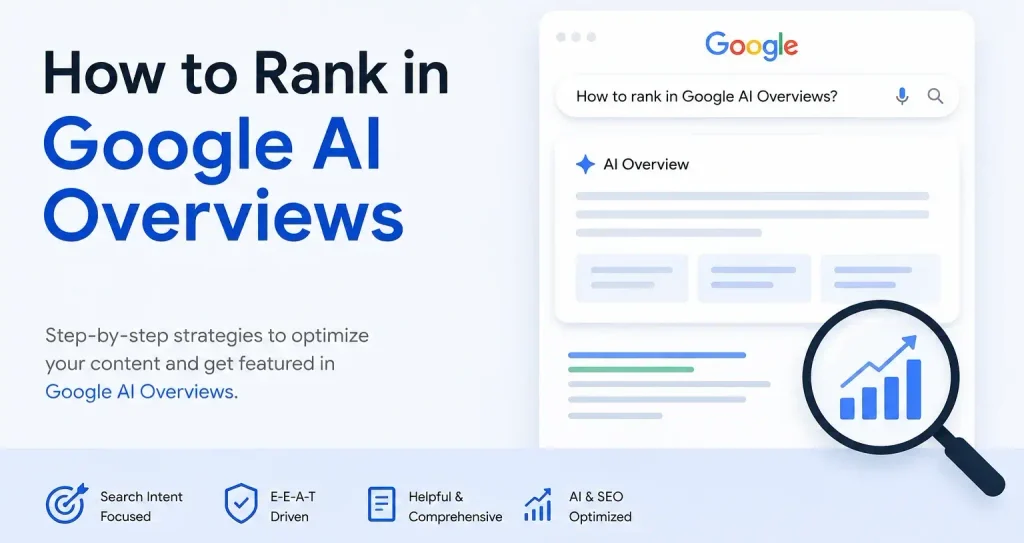
Google Search is evolving faster than ever. Users no longer rely solely on the traditional blue links in search results to find information. AI Overviews and AI Mode are creating a more conversational and answer-focused search experience.
For website owners and businesses, this raises a crucial question: how can you make your website more visible when Google uses AI to answer search queries?
The answer isn’t about finding a secret AI ranking trick. It is about combining solid SEO fundamentals with content that is useful, trustworthy, and genuinely helpful.
What are Google AI Overviews and AI Mode?
Google AI Overviews provide AI-generated answers for specific searches, helping users understand a topic without having to open multiple pages.
These answers may also include links to websites that Google considers relevant and authoritative.
This creates a new opportunity for businesses and publishers to reach audiences.
Instead of focusing solely on ranking at the #1 position, SEO professionals must now consider how their content can become a trusted source for AI-generated answers.
On the other hand side, Google AI Mode offers a more conversational way to search. Users can ask questions in detail, follow up with related queries, and explore a topic from different perspectives.
This makes context, relevance, depth, and topical authority even more important.
The goal is no longer just to rank for a specific keyword; the aim is to become a trusted source for the entire topic.
How to Rank in Google AI Overviews
There is no guaranteed way to get a webpage featured in AI Overviews. However, by adopting strong SEO and content practices, you can increase the likelihood of your website appearing in Google AI Overviews.
1. Create Original and Useful Content
The AI search experience relies on trustworthy information to provide relevant answers. Therefore, your content should offer genuine value rather than simply rewriting information that already exists online. When creating content, consider including:
- Original insights and practical experience
- Clearly explained methods
- Relevant examples
- Accurate and up-to-date information
- Answers to common user questions
- Actionable recommendations
Do not create content only for search engines; create it for the person searching.
Content that solves a real problem is more valuable than an article written primarily to insert keywords.
2. Precisely Match Search Intent
Understanding search intent is one of the most crucial aspects of modern SEO.
Before writing an article or blog post, ask yourself:
What does the user actually want to know?
For example, if someone searches for “how to rank in Google AI Overviews” they are likely looking for practical optimization techniques, not a basic definition of artificial intelligence.
Create your content around that intent and provide the answers as clearly as possible.
3. Build Strong Topical Authority
A single article on a competitive topic is unlikely to establish you as an expert.
Create supporting content on related topics and connect these pages using relevant internal links.
Think in terms of topics rather than individual keywords during creating content.
How to Rank in Google AI Mode
Ranking in Google AI Mode still requires a solid foundation of quality SEO, but your content also needs to be prepared for more complex and conversational search queries.
4. Provide Clear Answers to Specific Questions
Users in AI Mode may ask detailed questions that traditional keyword research might not capture.
Use natural questions in your content, such as:
- “How can I optimize my website for Google AI Mode?”
- “Does traditional SEO still work with AI search?”
- “What kind of content can appear in AI-generated search results?”
Provide a concise, clear answer first, followed by supporting information.
This makes it easier for both users and search systems to understand your content.
5. Strengthen Your Website’s Trust Signals
When your content is viewed as a source of information, trust matters.
Ensure your website clearly states the following:
- Who created the content
- Why the author is qualified
- When the content was last updated
- How users can contact the business
- What services or expertise the business offers
Include author details, credible references, case studies, and first-hand experience where appropriate.
6. Don’t Ignore Technical SEO
AI-focused SEO does not replace Technical SEO.
Your website’s technical foundation must remain strong. Pay attention to:
- Crawlability and indexability
- Mobile usability
- Page experience
- Website speed
- Internal linking
- Structured data (where necessary)
- Clean URL structure
- Proper canonicalization
If search engines cannot properly access and understand your website, even excellent content will not reach its full potential.
Future of SEO is AI-assisted, Not AI Only
AI is changing how people search, but it does not eliminate the fundamental principles of SEO.
High-quality content, technical accessibility, topical relevance, authority, and satisfying search intent remain essential.
The smartest strategy is to use AI to enhance research and workflow speed while keeping human expertise, experience, originality, and editorial judgment at the center.